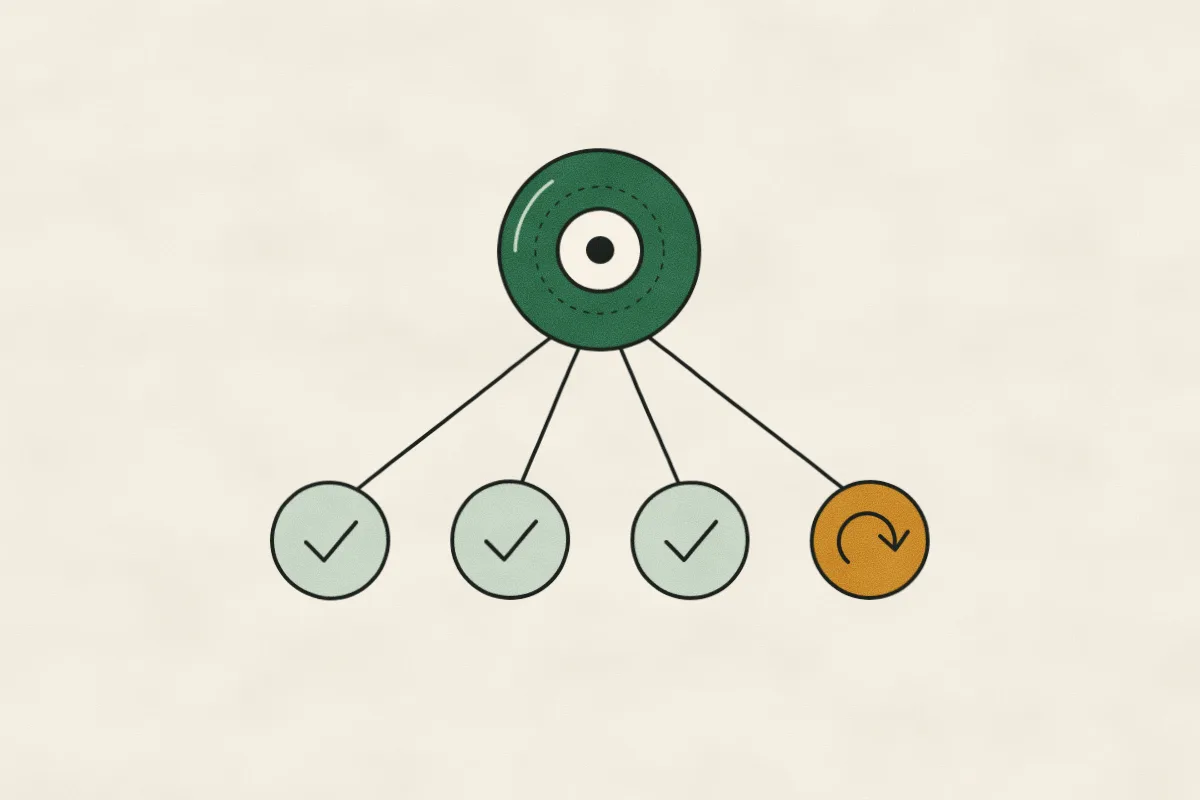
Set this project up as an orchestrator-and-workers system.

1. Create CLAUDE.md with: what this project is (ask me two questions if you can't tell from the files), the rules below, and a folder map. Create docs/progress.md, docs/decisions.md and docs/known-issues.md.
2. Rules for CLAUDE.md:
   - You (the main session) are the orchestrator. You plan, write briefs and check results. You don't do bulk work yourself when a worker can do it.
   - Pick the worker by how hard the job is. Quick, clearly defined work goes to the Haiku workers: finding files, renames, formatting, running tests, a small change to an exact brief. Work that needs judgment goes to the Sonnet workers: a feature across several files, a bug with no obvious cause, reviewing a diff.
   - Every brief states the goal, the files to read, and a "Done when:" check that can be run or seen.
   - Before accepting any worker's output, run its check yourself. If it fails, send it back with the failure. If a Haiku worker fails the same check twice, give the job to the engineer instead. Never pass on a worker's report unchecked.
   - Start of every session: read CLAUDE.md and the three docs. End of every session: update progress.md, add new decisions and gotchas, and propose skill edits with the evidence from this session. I approve them before you apply them.
3. Create four agents in .claude/agents/, each with model and effort in its frontmatter:
   - scout.md (model: haiku, effort: low): finds files and answers questions about the code, reports paths and line numbers, never edits.
   - builder.md (model: haiku, effort: medium): writes code to an exact brief, runs the check, reports what it ran.
   - engineer.md (model: sonnet, effort: high): builds the hard parts to a brief, runs the check, reports what it ran and what it wasn't sure about.
   - reviewer.md (model: sonnet, effort: high, read-only tools): reads a diff against a brief and lists what fails it.
4. Create .claude/skills/reflect/SKILL.md: at the end of a session, list what went wrong or took too long, propose the smallest edit to a skill or CLAUDE.md that would have prevented it, and wait for my OK.
5. Tell me the two settings to set by hand: /effort high for everyday work and /effort xhigh for big builds, and export CLAUDE_AUTOCOMPACT_PCT_OVERRIDE=40 in my shell before launching Claude Code. Remind me to leave CLAUDE_CODE_SUBAGENT_MODEL unset so each agent keeps its own model.

Show me every file before you write it.
Omega is my name for this setup. It isn't an Anthropic product, but the idea is theirs. Anthropic's own page for Haiku says: "A more intelligent model like Fable or Opus can plan the work and hand off subtasks to Haiku, making it practical to run many agents in parallel." Everything below is that sentence, set up so it runs the same way every session, with Sonnet added for the jobs that are too hard to hand a cheap model.
1. Opus 5.5 is the boss, at the effort the job needs
Type /model and pick Opus 5.5. Then set the effort for the work in front of you, instead of leaving it on one level forever. Opus 5.5 starts on medium.
| Effort | When I use it |
|---|---|
| /effort high | Everyday work: features, bug fixes, anything where checking the result matters |
| /effort xhigh | Very intense builds: many parts, many sessions, lots of agents to plan and check |
| /effort max | Rarely. Hard problems you leave it alone with, like a security audit. Anthropic says it can overthink, so test it first |
The boss plans the job, writes a brief for each worker and checks what comes back. It doesn't write the code itself, so its effort goes into planning and checking.
2. Haiku for quick work, Sonnet for hard work
Each worker is a file in .claude/agents/ with its own model and effort in the frontmatter. An agent's effort overrides the session's while it runs, so a Haiku scout stays fast even when the boss is on xhigh. The prompt makes four:
| Agent | Model | Effort | Its job |
|---|---|---|---|
| scout | Haiku 5.5 | low | Finds files and answers questions about the code. Never edits |
| builder | Haiku 5.5 | medium | Small, exact changes: renames, formatting, a function to a clear brief |
| engineer | Sonnet 5.5 | high | The hard parts: features across several files, bugs with no obvious cause |
| reviewer | Sonnet 5.5 | high | Reads a diff against the brief and lists what fails it |
---
name: engineer
description: Builds the hard parts of a job to a brief, runs the brief's check, reports what it ran.
model: sonnet
effort: high
---

You get a brief with a goal, the files to read and a "Done when:" check.
Do the work, run the check, and report the exact command you ran and its output.
Say what you weren't sure about. Don't report done until the check passes.
The split is the point. Haiku is great when the job has one right answer and the brief spells it out. When the job needs judgment, a cheap model that fails three times costs more than Sonnet getting it right once, so a Haiku job that fails its check twice moves up to the engineer. Add more agents the same way, one job each, and give each the cheapest model and lowest effort that passes its check.
Leave the subagent model variable below unset. With its FORCE twin set to 1, it puts every agent on one model and ignores the model line in each file, which undoes the split.
CLAUDE_CODE_SUBAGENT_MODEL
CLAUDE_CODE_SUBAGENT_MODEL_FORCE
3. Every agent gets a goal and a check
Every brief ends with "Done when:" and something you can run or see: a test that passes, a file that exists, a number on the screen. The boss reruns that check itself before it accepts the work. If it fails, the work goes back to the worker with the failure attached. That loop is why cheap agents don't hand you junk.
4. Compact at 40%, or 60% on big jobs
Claude gets worse at recalling things as its context fills up. Anthropic calls it context rot. Compacting early keeps the boss sharp. Run this in your shell before you start Claude Code, and use 60 instead of 40 for long builds:
export CLAUDE_AUTOCOMPACT_PCT_OVERRIDE=40Lower numbers compact earlier. The setting can only make compaction happen sooner, never later, and it works for subagents too. Type /context during a session to see how full it is.
5. One folder system
Every agent reads the same map, so nobody goes looking for where things live. This is the layout the prompt sets up:
CLAUDE.md               what this project is, the rules, where everything lives (read first, every session)
docs/progress.md        where we are: done, next, a dated log line per session
docs/decisions.md       what's settled, with the date and why
docs/known-issues.md    gotchas and their fixes
.claude/agents/         worker agents, each with its own model, effort and one job
.claude/skills/         one folder per repeatable task, each with a SKILL.md
6. Skills that get better after every session
At the end of a session, the reflect skill lists what went wrong or took too long and proposes the smallest edit to a skill or to CLAUDE.md that would have stopped it. You read the edit and say yes or no. Nothing changes without your OK, so the skills only get better from things that actually happened. Skills take model and effort lines in their frontmatter too, if one needs more thinking than the rest.
What it costs
| Model | Input, per million tokens | Output, per million tokens |
|---|---|---|
| Opus 5.5 | $4 | $20 |
| Sonnet 5.5 | $2 | $10 |
| Haiku 5.5 | $0.10 | $0.50 |
A Haiku token costs a fortieth of an Opus token, and a Sonnet token half. Haiku's price goes up to $0.50 and $2.50 on prompts over 100,000 tokens, which is one more reason to keep worker briefs short. More agents means more tokens in total. Anthropic measured multi-agent systems using about 15 times the tokens of a chat, so the saving is in the price of each token, not the count. Higher effort also spends more tokens, which is why the boss isn't on xhigh for a typo.
Claude Code also has a built-in version. Type /effort ultracode and, for every substantive task, Claude plans a workflow that runs many subagents from a script, dozens to hundreds per run and up to 16 at once by default. It doesn't change your effort level, and /effort ultracode off turns it back off.
- SubagentsAgent files, and the model and effort fields.
- Model and effortEvery /model and /effort option, and what each level is for.
- PricingPer-token prices for every model.
- Environment variablesCLAUDE_AUTOCOMPACT_PCT_OVERRIDE and the rest.
- LoadoutThe skill that checks which of the eight harness pieces your project is missing.